Selected applied AI and product-engineering work, led by projects that can be opened, tested, or inspected.
A note on evidence
Public work first. Private work labeled.
Live products and source code are linked directly. For private systems, I show the problem,
implemented controls, and a sanitized architecture without presenting internal claims as independent proof.
An LLM-powered Q&A layer for my personal blog that lets visitors ask across published articles and receive concise, context-grounded answers.
Problem
A growing archive is difficult to explore one post at a time, especially when a visitor arrives with a specific question rather than a title or keyword.
What I built
I implemented a site-grounded AI chat experience on sarojbartaula.com that answers questions across my published archive and background.
It turns a static reading experience into an interactive way to discover relevant ideas and source context.
Product decisions
Grounded the experience in my public writing and background instead of presenting it as a general-purpose chatbot
Used conversational questions to reduce the effort of searching across an archive
Deployed the feature on the live personal site so reviewers can evaluate the product experience directly
What this shows
Hands-on LLM product integration, conversational interface design, and the ability to add a useful AI layer to an existing web product.
Technical scope
RAG, LLM integration, content retrieval and grounding, conversational UI, web product engineering
A video-to-skeleton motion-intelligence pipeline for turning human movement into structured information for sports, fitness, and physical-AI workflows.
Problem
Raw video is rich in visual information but difficult for downstream products to query, compare, and use as structured motion data.
What I built
A pipeline that extracts human movement signals from video and transforms them into structured skeletal and motion features.
Engineering focus
Improving landmark stability under camera, lighting, and movement variation
Normalizing motion representations so repeated clips can be compared consistently
Designing outputs that can support analytics, feedback products, and later physical-AI use cases
A Slack-first engineering assistant for task intake, GitHub pull-request workflows, CI monitoring, failure summaries, and guarded automation.
Role and ownership
I owned the architecture and implementation end to end, from API design and workflow orchestration to deployment and security hardening.
What I built
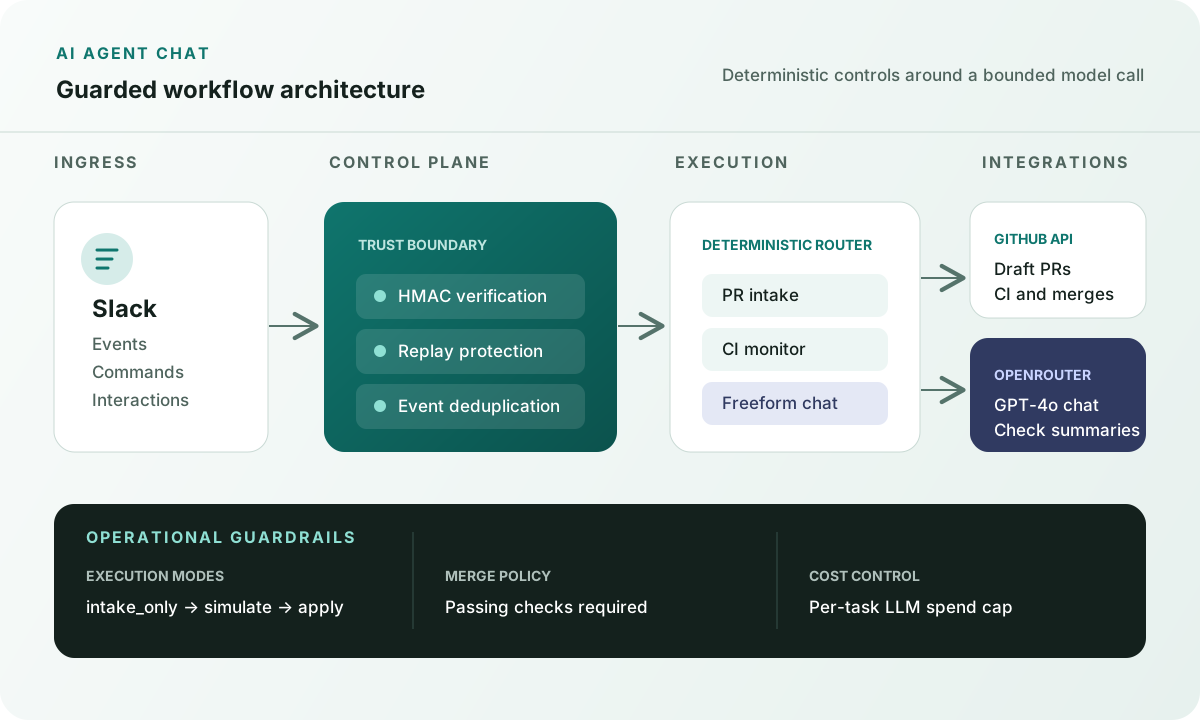
A Slack assistant that captures ideas and tasks, opens GitHub draft pull requests, monitors CI, gates merges behind passing checks, summarizes failures with an LLM, and supports freeform conversations.
Sanitized system architecture. Deterministic controls surround the model call; private deployment details are omitted.
Security and reliability controls
HMAC-SHA256 verification on Slack and GitHub webhook endpoints
Timestamp validation and event deduplication to limit replay and retry behavior
Separate deterministic command routing from freeform LLM conversations
Staged execution modes and per-task spend limits for controlled automation
Smaller experiments that show technical range without presenting them as finished public products.
Model Training & Adaptation
Built and trained a 423K-parameter TinyGPT from scratch on custom text for 3,000 CPU steps, covering tokenization, context windows, Transformer blocks, training, evaluation, and generation. Also tested Hugging Face Qwen and PEFT/LoRA adaptation workflows.
Python · PyTorch · Hugging Face · PEFT/LoRA · Qwen · Linux